

Turning Workflows Into Autonomous Systems With Agentic AI
Businesses today are under pressure to move faster, scale smarter, and reduce manual coordination. This is where autonomous systems with Agentic AI come in. Instead of managing workflows step by step, organizations are now learning how to turn workflows into autonomous systems that can think, decide, and act on their own.
This blog explains what autonomous workflows really mean, how agentic AI workflows enable them, and how businesses can transition safely and strategically.

What Are Autonomous Systems With Agentic AI?
Autonomous systems with Agentic AI are AI-driven systems that can independently plan, make decisions, and execute actions across workflows to achieve defined outcomes, without constant human intervention.
Unlike traditional automation, these systems adapt to context, handle exceptions, and continuously optimize their behavior. Related Read: Agentic AI Vs Generative AI
Workflow vs Autonomous System
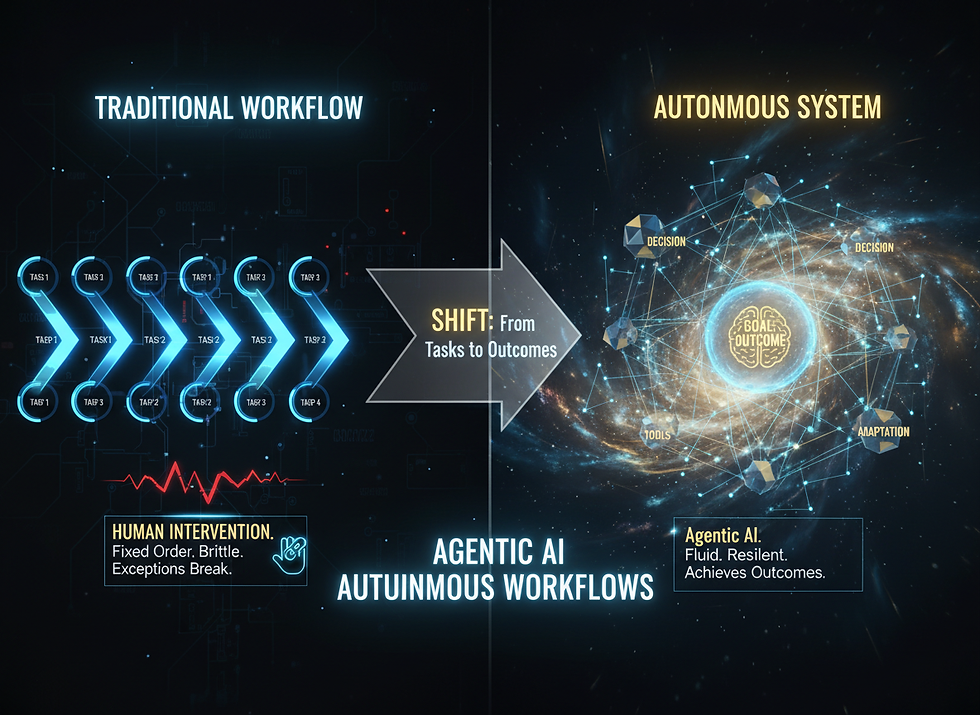
A traditional workflow follows predefined steps. It executes tasks in a fixed order and breaks when conditions change or exceptions occur. Human intervention is required whenever something unexpected happens.
An autonomous system, on the other hand, understands the goal of the workflow. It decides what steps are required, chooses the right tools, adapts to changing inputs, and escalates only when necessary. The focus shifts from managing tasks to achieving outcomes.
This shift is what enables agentic AI autonomous workflows.
The Role of Agentic AI: How Autonomy Is Achieved
Agentic AI is the intelligence layer that transforms workflows into autonomous systems. It gives AI the ability to reason about goals, plan multi-step actions, use tools, and evaluate results.
Instead of asking, “What step comes next?”, Agentic AI asks, “What should I do to achieve this outcome?” This goal-oriented reasoning is what differentiates agentic AI workflows from simple automation or scripts.
Step-by-Step: Turning Workflows Into Autonomous Systems
The transformation begins by defining the outcome, not the steps. Businesses must clearly specify what success looks like and where the AI is allowed to act.
Next, suitable workflows are identified, typically those involving repetitive decisions, multiple systems, and frequent human coordination. These workflows are then redesigned so that Agentic AI can plan actions rather than follow rigid rules.
Once redesigned, the agent is connected to existing tools such as CRMs, ERPs, ticketing systems, or databases through APIs. The final step is governance: adding approval checkpoints, monitoring, and escalation rules before scaling autonomy.
This is the foundation of turning workflows into autonomous systems responsibly.

Real-World Example
Consider an IT incident management workflow. Traditionally, alerts are reviewed manually, tickets are assigned, diagnostics are run, and fixes are coordinated across teams.
With Agentic AI, the system detects the incident, diagnoses the issue, executes approved remediation steps, verifies resolution, and documents the outcome automatically. Humans intervene only if predefined risk thresholds are crossed.
The workflow becomes an autonomous system focused on resolution, not task execution.
Levels of Autonomy
Not all autonomous AI systems operate at the same level. Some function as decision-support agents that recommend actions but require approval. Others operate semi-autonomously, executing actions within strict boundaries. Fully autonomous systems act end-to-end with minimal human involvement.
Most organizations start with low to medium autonomy and increase it gradually as trust, governance, and reliability improve.
Governance, Control & Safety
Autonomy without control is risky. Governance is what makes autonomous AI systems viable in real-world environments.
Effective controls include human-in-the-loop approvals, permission limits, audit logs, continuous monitoring, and clear escalation paths. Safety mechanisms ensure that Agentic AI acts within defined ethical, operational, and regulatory boundaries.
Successful organizations design governance alongside autonomy, not after deployment.

Why Businesses Are Moving Toward Autonomous AI Systems
The real value of Agentic AI lies in its ability to coordinate across tools, adapt to change, and reduce operational friction. As systems become more complex, human-led coordination does not scale. Autonomous AI systems fill this gap by managing complexity intelligently.
This is why many enterprises see Agentic AI as the next evolution of digital operations.
Final Takeaway
Turning workflows into autonomous systems is not about removing humans, it’s about removing friction. With the right balance of autonomy and control, agentic AI workflows enable businesses to scale intelligence, not just automation.
FAQs
1. What does it mean to turn workflows into autonomous systems?
It means redesigning workflows so they can independently plan, decide, and execute actions to achieve outcomes, rather than following fixed steps.
2. How does Agentic AI enable autonomous workflows?
Agentic AI provides goal-based reasoning, decision-making, tool usage, and adaptability, allowing workflows to operate without constant human input.
3. Is Agentic AI the same as automation?
No. Automation follows predefined rules, while Agentic AI adapts, makes decisions, and handles exceptions autonomously.
4. How do you build autonomous systems using Agentic AI?
By defining outcomes, selecting suitable workflows, enabling agentic reasoning, integrating tools via APIs, and implementing governance controls.
5. What level of autonomy can Agentic AI have?
Agentic AI can range from decision-support to fully autonomous execution, depending on risk tolerance and governance maturity.
6. What are the risks of autonomous AI systems?
Risks include uncontrolled actions, compliance issues, and unintended outcomes, which can be mitigated through monitoring and human oversight.
7. When should businesses avoid full autonomy?
Businesses should avoid full autonomy in unstable processes, high-risk decisions, or environments lacking governance and accountability.
#AgenticAI #AIAgents #AutonomousWorkflows #ArtificialIntelligence #AI #Automation #FutureOfWork #DigitalTransformation #Innovation #TechTrends2026 #IntelligentAutomation #AgenticWorkflows #Hyperautomation #EnterpriseAI #MultiAgentSystems #SaaS #Efficiency #OperationalExcellence #B2B #SmartWorkflows #MachineLearning #AIOps


Comments