

The Future of Sports Retail: Automated Sales Systems That Work 24/7

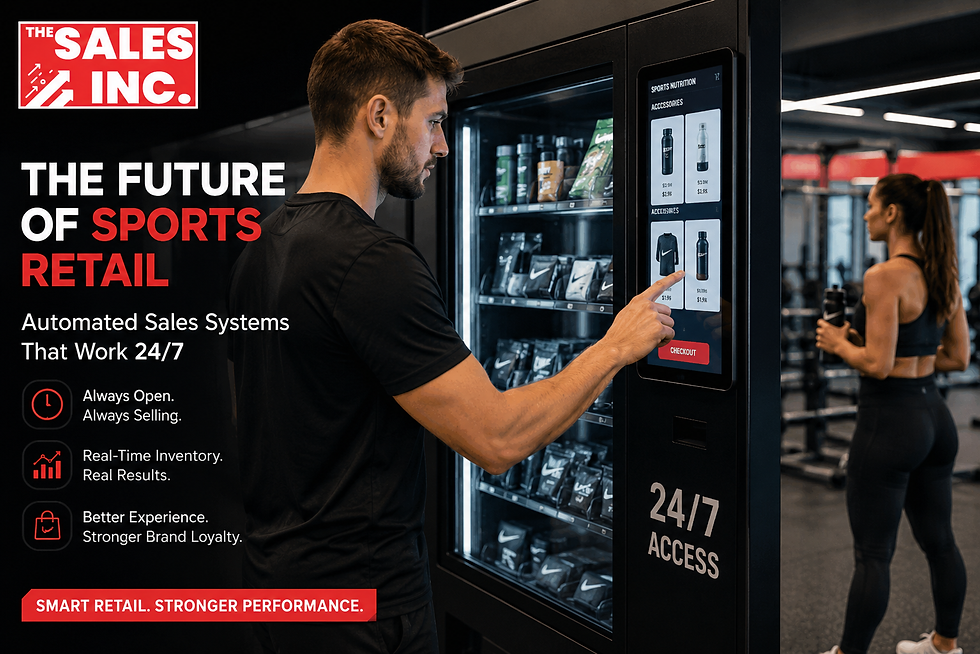
The sports retail industry is undergoing a fundamental transformation. The traditional model of staffed retail environments with fixed operating hours, manual inventory management, and cash-based transactions is giving way to a new generation of technology-driven retail experiences that operate continuously, respond to customer behaviour in real time, and deliver a level of convenience that fixed-format retail simply cannot match.
Automated sales systems are at the centre of this transformation. From smart vending solutions in gyms and stadiums to fully automated retail stores that operate without staff, sports retail automation is reshaping how sports products are sold, how inventory is managed, and how sports brands connect with their customers at the moments when purchase intent is highest. This guide explores how these systems work, why sports retail is adopting them rapidly, and what the future of automated retail systems looks like for businesses that are willing to invest in the infrastructure of 24/7 commercial capability.
What Are Automated Sales Systems?
Understanding Retail Automation Technology
Automated sales systems are technology-driven retail infrastructure that enables products to be merchandised, selected, paid for, and dispensed without requiring human staff involvement in the transaction. At their simplest, they include smart vending machines and self-checkout terminals. At their most sophisticated, they encompass fully autonomous retail environments equipped with computer vision, AI-powered inventory management, frictionless payment systems, and real-time analytics that give operators complete visibility into sales performance, stock levels, and customer behaviour.
The defining characteristic of automated sales technology is that it decouples commercial activity from staff availability. A staffed retail environment can only generate revenue when people are present and working. An automated retail system generates revenue continuously, responds to customer demand at any hour, and maintains operational consistency regardless of staffing constraints, seasonal pressures, or unexpected disruptions. For sports retail specifically, where purchase occasions are often tied to specific activities, events, and training sessions that happen outside conventional retail hours, this decoupling from staff dependency represents a fundamental improvement in commercial capability.
How 24/7 Automated Retail Systems Work
24/7 retail sales systems operate through an integrated combination of hardware, software, and connectivity that manages the entire retail transaction from product presentation to payment to dispensing or access without human intervention at any stage.
The customer-facing layer typically involves a digital interface, either a touchscreen kiosk, a mobile application, or a combination of both, through which customers browse available products, select what they want, and complete payment. The payment processing layer handles cashless and contactless transactions in real time, integrating with major payment networks and digital wallets. The fulfilment layer manages the physical dispensing of products, either through automated vending mechanisms, smart lockers, or access control systems depending on the product type and retail format. And the management layer connects all of these elements through a cloud-based software platform that provides operators with real-time visibility into sales, inventory levels, system performance, and customer behaviour from any location. The integration of these layers into a seamless customer experience is what makes modern automated retail systems so significantly more capable than earlier generations of vending technology.
Why Sports Retail Is Moving Toward Automation?
Demand for Faster Customer Experiences
Sports retail customers are, almost by definition, time-conscious. A gym member who arrives for a early morning workout and realises they have forgotten their training gloves has approximately two minutes of interest in solving that problem before they move on. A stadium visitor looking for team merchandise between the warm-up and kick-off has a similarly narrow window of purchase intent. A runner who finishes a parkrun and wants to buy a replacement water bottle before the drive home is making an impulse decision that either gets captured immediately or not at all.
The friction inherent in traditional staffed retail, locating a member of staff, waiting in a queue, handling cash, asking for assistance, is fatal to these time-sensitive purchase occasions. Automated sales systems eliminate that friction entirely, delivering a purchase experience that takes under a minute from product selection to transaction completion. This speed alignment with the sports customer's purchasing behaviour is one of the primary commercial drivers of automation adoption in sports retail, and it translates directly into higher capture rates for impulse and convenience purchases that would otherwise be lost.
Need for Around-the-Clock Product Access
Sports activity does not respect retail opening hours. Gym members train at five in the morning and eleven at night. Endurance athletes prepare for early starts and recover from late finishes. Sports venues host events at times that fall entirely outside the operating hours of conventional retail. The demand for sports products, whether that is nutrition, equipment, apparel, or accessories, follows the rhythm of sports activity rather than the rhythm of retail convention.
Sports retail automation resolves this misalignment fundamentally by making products available whenever customers need them. A gym that can sell protein shakes, recovery supplements, and training accessories at any hour of the day or night without a single additional staff hour is capturing revenue that would otherwise be entirely lost. A sports venue with automated merchandise and equipment retail that operates throughout an event rather than only during staffed window periods is serving a broader portion of its potential customers. The commercial benefit of removing the operating hours constraint from retail activity is one of the clearest and most straightforward value propositions of 24/7 automated retail systems.
Reducing Operational Costs and Staffing Challenges
The labour market dynamics affecting retail across all sectors have made the staffing cost component of traditional retail increasingly difficult to manage. Recruiting, training, scheduling, and retaining retail staff, particularly for the unsocial hours and variable demand patterns that characterise sports environments, represents a significant and growing operational cost that directly compresses retail margins.
Automated retail systems address this challenge structurally rather than operationally. Rather than attempting to manage staffing costs through scheduling optimisation and wage management, automation removes the dependency on human staff for transactional retail activity altogether. The operational cost of an automated retail system is largely fixed and technology-based rather than variable and labour-based, which changes the economics of retail significantly at higher volumes. Maintenance, connectivity, software licensing, and occasional hardware servicing replace hourly wages, employer contributions, and the significant hidden costs of staff turnover that affect most retail operations.
Key Features of Modern Automated Sales Systems
Smart Inventory Tracking
Modern automated sales systems incorporate real-time inventory tracking that monitors stock levels continuously, generates automatic reorder alerts when defined thresholds are reached, and provides operators with complete visibility into product movement patterns that inform both restocking decisions and product range optimisation.
Smart inventory tracking in sports retail environments goes beyond simple stock counting to provide actionable commercial intelligence. Operators can identify which products sell fastest at specific times of day, which locations generate the highest revenue per square foot, which product combinations are most frequently purchased together, and how sales patterns correlate with external factors like weather, events, and seasonal activity levels. This intelligence transforms inventory management from a reactive operational task into a proactive commercial capability that improves margin, reduces waste, and ensures that the right products are available in the right locations at the right times.
Cashless and Contactless Payments
The transition to cashless retail has accelerated significantly across all retail formats, and automated sales systems in sports environments are designed from the ground up to support the full range of contactless payment options that customers now expect as standard. Credit and debit card contactless, mobile payment platforms, digital wallets, and QR code-based payment systems are all supported within modern automated retail infrastructure, enabling payment completion in seconds without any cash handling requirement.
For sports retail specifically, cashless payment capability is particularly valuable because sports environments are settings where customers frequently have limited cash but immediate access to their phone or a contactless card. A runner who does not carry a wallet but always has their phone, a gym member whose only pocket holds their key fob and a bank card, a stadium visitor navigating a crowded concourse with limited time, all are served more effectively by cashless automated retail than by any format requiring cash handling or staff-mediated payment.
Self-Service Purchasing Experiences
The self-service purchasing experience at the heart of automated retail systems must be designed to be intuitive, fast, and satisfying for customers with no prior instruction. The best implementations in sports retail achieve this by combining clear product presentation with a navigation interface that requires minimal steps from product discovery to transaction completion, and by providing sufficient product information within the interface to allow customers to make confident purchase decisions without assistance.
For sports products specifically, where technical specifications, sizing, and compatibility with existing equipment can all be relevant to the purchase decision, the product information layer of the self-service interface is particularly important. Customers who cannot find the information they need to complete a purchase confidently will abandon the transaction, so the investment in comprehensive, well-presented product content within the automated retail interface directly affects conversion rates and revenue performance.
Real-Time Retail Analytics
The analytical capability of modern automated sales systems represents one of the most significant advantages over traditional retail formats, providing operators with a level of insight into sales performance, customer behaviour, and operational efficiency that manual retail processes cannot match.
Real-time dashboards give operators instant visibility into which products are selling, which locations are performing best, when sales peaks are occurring, and how current stock levels compare to demand patterns. Historical analysis reveals trends and patterns that inform product range decisions, pricing strategies, and location planning. And operational monitoring provides immediate alerts when systems require attention, ensuring that technical issues are identified and addressed before they result in lost sales or customer experience failures.
Benefits of Automated Sales
Systems in Sports Retail
Improved Customer Convenience
Customer convenience in sports retail automation is not simply about making purchases easier, although it achieves that clearly. It is about aligning the purchase opportunity with the moment of highest purchase intent, which in sports retail is almost always immediately before or immediately after an activity rather than during a separate shopping trip.
When a gym member can buy a pre-workout supplement thirty seconds before their session begins, or when a stadium visitor can purchase a team jersey without missing any of the match, or when a sports club member can access equipment immediately when they need it, the purchase experience feels natural and effortless rather than requiring deliberate effort. This alignment between purchase opportunity and purchase intent is the fundamental driver of customer satisfaction with automated retail systems and the commercial performance that results from it.
24/7 Product Availability
Around-the-clock product availability transforms the commercial model of sports retail by making revenue generation independent of operating hours. For gyms that see significant membership activity during hours when no retail staff would typically be present, for sports venues that host evening and weekend events, and for sports retailers looking to capture sales from customers who are not able to shop during conventional hours, the revenue contribution of 24/7 availability is both immediate and ongoing.
The compounding benefit of always-on availability becomes visible over time as operators identify the sales patterns that emerge outside conventional retail hours and optimise product ranges and stock levels to serve those patterns effectively. Revenue that would previously have been structurally inaccessible becomes a consistent and forecastable part of the business, which changes how the operation is planned and resourced.
Better Inventory Management
The inventory management capability of automated retail systems produces efficiency improvements that extend beyond simply reducing stockouts. Real-time visibility into stock levels across multiple locations allows operators to manage inventory more dynamically, redistributing stock between locations based on actual demand patterns rather than periodic manual reviews. Automatic reorder triggers ensure that popular products are replenished before they run out rather than after, which eliminates the lost sales and customer frustration associated with empty shelves.
Waste reduction is another significant inventory management benefit, particularly for sports nutrition products with defined shelf lives. Automated tracking of stock age and rotation enables first-in-first-out management that reduces waste and the margin erosion associated with disposing of expired stock. This connects directly to the broader principle of using data and systems to reduce operational cost while improving output, which is central to how businesses reduce customer acquisition cost through automation across their entire commercial operation.
Increased Retail Efficiency
Operational efficiency in automated sports retail manifests across multiple dimensions simultaneously. Staff time previously spent on transactional retail activity is freed for higher-value customer interaction, facility management, and the relationship-building work that staffed sports environments are uniquely positioned to deliver. The consistency of automated processes eliminates the variability in customer experience that results from differences in individual staff performance. And the scalability of automated systems means that increasing sales volume does not require proportional increases in operational cost, which improves the economics of growth in ways that staffed retail formats cannot replicate.
Common Applications in Sports Retail
Gyms and Fitness Centers
Gyms and fitness centres are among the most natural environments for sports retail automation, combining a captive, time-constrained customer base with predictable and recurring product demand across nutrition, accessories, and apparel categories. Automated retail in gym environments typically focuses on high-frequency convenience purchases, including protein supplements, energy drinks, training accessories like gloves and wraps, and personal care products, that members want to be able to access quickly before or after training without disrupting their workout routine.
The operational case for automation in gym retail is particularly strong because gym operating hours frequently extend well beyond the hours when staffing retail positions is economically viable. An automated system that serves the early morning and late evening training sessions that are often the busiest periods in a gym captures revenue that a staffed retail operation would miss entirely.
Stadiums and Sports Venues
Stadiums and sports venues present a distinct set of retail opportunities and challenges that make automated systems particularly valuable. The concentrated demand at specific periods, primarily around event start and end times and at half-time or between periods, creates peak pressure on traditional staffed retail that results in long queues, frustrated customers, and significant lost sales. Automated retail infrastructure distributed throughout the venue can absorb a significant portion of this peak demand, reducing queues at staffed outlets and ensuring that customers who cannot access staffed concessions can still purchase the products they want.
Merchandise automation in particular is a significant opportunity for sports venues, where team apparel and accessories generate substantial revenue during events but where staffed merchandise outlets are typically limited in number and location. Automated merchandise systems can be deployed throughout a venue at relatively low cost, bringing the purchase opportunity directly to where customers are rather than requiring them to travel to a central retail area.
Sports Equipment and Apparel Stores
Sports equipment and apparel retailers are increasingly exploring automated retail formats both as standalone operations and as extensions of existing staffed store environments. Automated systems within staffed stores can handle after-hours sales, reducing the revenue loss associated with closing time, and can serve as dedicated high-speed checkout options that reduce queuing during peak trading periods.
Standalone automated sports retail formats, including fully autonomous stores that operate entirely without staff, are becoming increasingly viable as the technology matures and the customer familiarity with self-service retail experiences grows. These formats are particularly interesting for locations where the economics of a fully staffed store are challenging but where demand justifies a retail presence, including transport hubs, residential developments with integrated amenity retail, and sports facility environments where footfall is strong but operating hours are unpredictable.
Pop-Up and Mobile Retail Locations
The flexibility of modern automated retail technology makes it well-suited to temporary and mobile retail applications that would be impractical or uneconomical with staffed formats. Sports events, endurance races, outdoor festivals, and seasonal sports environments all represent commercial opportunities where a temporary automated retail presence can capture significant revenue without the logistical complexity of deploying and managing a staffed retail operation.
Mobile automated retail units that can be transported, deployed, and restocked with minimal effort give sports brands and retailers the ability to bring their products directly to their customers at the events and locations where purchase intent is highest, creating revenue opportunities that would otherwise be entirely inaccessible. This is consistent with the broader principle of meeting customers where they are with relevant products at the right moment, which is as important in physical retail as it is in building a predictable revenue channel through digital marketing.
Challenges and Considerations
Initial Technology Investment
The upfront investment required to implement automated retail systems is the most commonly cited barrier to adoption, particularly for smaller sports businesses and independent retailers. Hardware costs for modern automated retail infrastructure, including the kiosk or vending hardware, payment processing equipment, and connectivity systems, represent a meaningful capital commitment that requires careful evaluation against the projected revenue and efficiency returns.
The evaluation framework for this investment should account for the full commercial benefit rather than simply the cost reduction. Revenue generated outside current operating hours, sales captured from customers who would otherwise have been lost to queue abandonment or inconvenience, and the margin improvement from better inventory management all contribute to the return on the technology investment alongside the operational cost savings from reduced staffing requirements.
System Maintenance and Security
Automated retail systems require ongoing maintenance to operate reliably, and the consequences of technical failures are more commercially significant than in staffed retail environments because there is no human resource to compensate when technology fails. System maintenance protocols, service level agreements with technology providers, and clear processes for rapid fault resolution are all essential operational requirements for automated retail deployments.
Security is a related consideration, covering both the physical security of hardware assets and the data security of payment and customer information processed through the system. Modern automated retail platforms incorporate comprehensive security measures at both the physical and digital layers, but operators must ensure that their implementation follows best practice and complies with relevant data protection requirements.
Balancing Automation With Customer Service
The most effective sports retail environments use automation and human service as complementary rather than competing elements of the customer experience. Automated systems handle transactional interactions, high-volume convenience purchases, and after-hours sales most effectively. Human staff add the most value in advisory interactions, complex purchase decisions where expertise and guidance improve the outcome, and relationship-building that creates the loyalty and advocacy that drives long-term customer value.
Getting this balance right requires honest evaluation of where human involvement genuinely adds value in a specific retail context rather than defaulting to either full automation or full staffing as a blanket approach.
The Future of Automated Sports Retail
AI-Driven Retail Experiences
The next generation of automated sales systems for sports retail will be defined by artificial intelligence that makes the retail experience progressively more personalised, predictive, and commercially sophisticated. AI-powered recommendation engines will analyse individual customer purchase history, activity patterns, and preferences to deliver product suggestions that feel like advice from a knowledgeable specialist rather than generic upsell prompts. Computer vision systems will enable frictionless retail formats where customers select products and walk out without any explicit payment interaction, with transactions processed automatically based on what was taken. And predictive inventory management will anticipate demand based on multiple data inputs, including event schedules, weather forecasts, and seasonal patterns, to ensure that stock levels are optimised before demand peaks rather than adjusted reactively after stockouts occur.
Smart Retail Ecosystems
The evolution of sports retail automation is moving toward fully integrated retail ecosystems where the automated retail infrastructure is connected to the broader digital environment of the sports facility or brand. Gym membership systems that recognise members at automated retail points and apply their loyalty benefits automatically. Stadium apps that allow fans to pre-order merchandise for collection from automated lockers, eliminating queuing entirely. Sports brand platforms that connect online and offline purchase history to deliver a seamless experience regardless of which channel the customer uses. These integrated ecosystems create a customer experience that feels genuinely personalised and frictionless, which is increasingly the expectation that sports consumers bring to their retail interactions.
Personalized and Data-Driven Shopping
The data generated by automated retail systems is one of its most strategically valuable outputs, providing insights into customer behaviour, product performance, and location efficiency that inform decisions across the entire sports retail business. As the sophistication of data analytics applied to this information increases, the commercial decisions it enables will become progressively more precise. Pricing optimisation based on real-time demand signals. Product range decisions informed by granular sales performance data rather than buyer intuition. Location planning guided by footfall analysis and revenue per interaction data that identifies where automated retail investment generates the highest return. The sports retailers that invest in building their automated retail capability now will enter this more data-rich future with accumulated operational experience and customer insight that represents a significant competitive advantage over those starting from scratch.
Conclusion
Automated sales systems are not a future possibility for sports retail. They are a present reality that is reshaping the commercial landscape of the industry right now, and the gap between businesses that have invested in automated retail capability and those that have not is already visible in revenue performance, operational efficiency, and customer experience quality.
The sports retailers, gyms, stadiums, and sports brands that build their sports retail automation capability now will benefit from the compounding advantages of accumulated operational experience, customer data, and system refinement that make automated retail progressively more effective over time. Those that wait will find the investment case stronger but the competitive disadvantage larger.
24/7 retail sales systems represent the same fundamental shift in commercial capability that digital marketing automation represents for customer acquisition, moving from a model dependent on human availability and manual effort to one where well-designed systems work continuously, improve automatically, and generate revenue regardless of what else is happening in the business. Building that capability, whether in retail operations, marketing systems, or customer communication infrastructure, is the strategic investment that separates sports businesses with sustainable competitive advantage from those perpetually constrained by the limits of manual operation. If your business needs the strategic leadership to make these investments in a coordinated, commercially focused way, a Fractional CMO brings exactly that kind of thinking to growing businesses that need senior marketing and commercial guidance without the overhead of a full-time hire.
Frequently Asked Questions
How does retail automation improve customer convenience?
By eliminating the friction of staffed retail, including waiting for assistance, queuing for payment, and operating within fixed hours, and replacing it with an instant, self-directed purchase experience that takes seconds from product selection to transaction completion. For sports customers whose purchase occasions are time-sensitive and often tied to specific activities, this friction elimination translates directly into higher purchase completion rates and better overall customer satisfaction.
What technologies are used in automated sports retail?
Modern automated sports retail systems typically incorporate touchscreen or mobile app interfaces, contactless and cashless payment processing, automated vending or smart locker dispensing mechanisms, computer vision for product identification in advanced formats, cloud-based inventory and sales management software, and real-time analytics platforms that aggregate performance data across multiple locations.
Are automated sales systems suitable for gyms and stadiums?
Yes, both are excellent environments for automated retail. Gyms benefit from around-the-clock product availability that serves the early morning and late evening training sessions that are often their highest-demand periods. Stadiums benefit from distributed automated retail infrastructure that manages peak demand at event times without the queuing and lost sales associated with limited staffed concession points.
Can automated retail systems improve inventory management?
Yes, significantly. Real-time stock tracking, automatic reorder alerts, and demand pattern analytics enable a level of inventory management precision that manual processes cannot match. This reduces stockouts, minimises waste, and improves the commercial efficiency of the product range by ensuring that the right products are available in the right locations at the right times.
What are the benefits of self-service retail systems?
The key benefits are instant transaction completion without queuing, product availability at any hour without staffing cost, consistent and accurate inventory management, real-time sales analytics, and the ability to deploy retail capability in locations and at times where staffed retail would not be economically viable.
Why is sports retail adopting automation technology?
The primary drivers are the demand for faster, more convenient customer experiences, the commercial opportunity of making products available outside conventional retail hours, and the need to reduce the operational cost and complexity of staffed retail in environments where labour costs are rising and staff availability is increasingly challenging.
How do 24/7 automated retail systems work?
They combine customer-facing digital interfaces for product selection with integrated cashless payment processing, automated product dispensing or access mechanisms, and cloud-based management software that gives operators real-time visibility into sales, stock levels, and system performance from any location. All elements operate continuously without requiring staff availability for individual transactions.
What are automated sales systems in sports retail?
Automated sales systems are technology-driven retail infrastructure that enables products to be purchased and received without requiring human staff involvement in the transaction. They range from smart vending machines and self-checkout terminals to fully autonomous retail stores, and they are characterised by their ability to operate continuously, manage inventory in real time, and process cashless payments instantly.


Comments